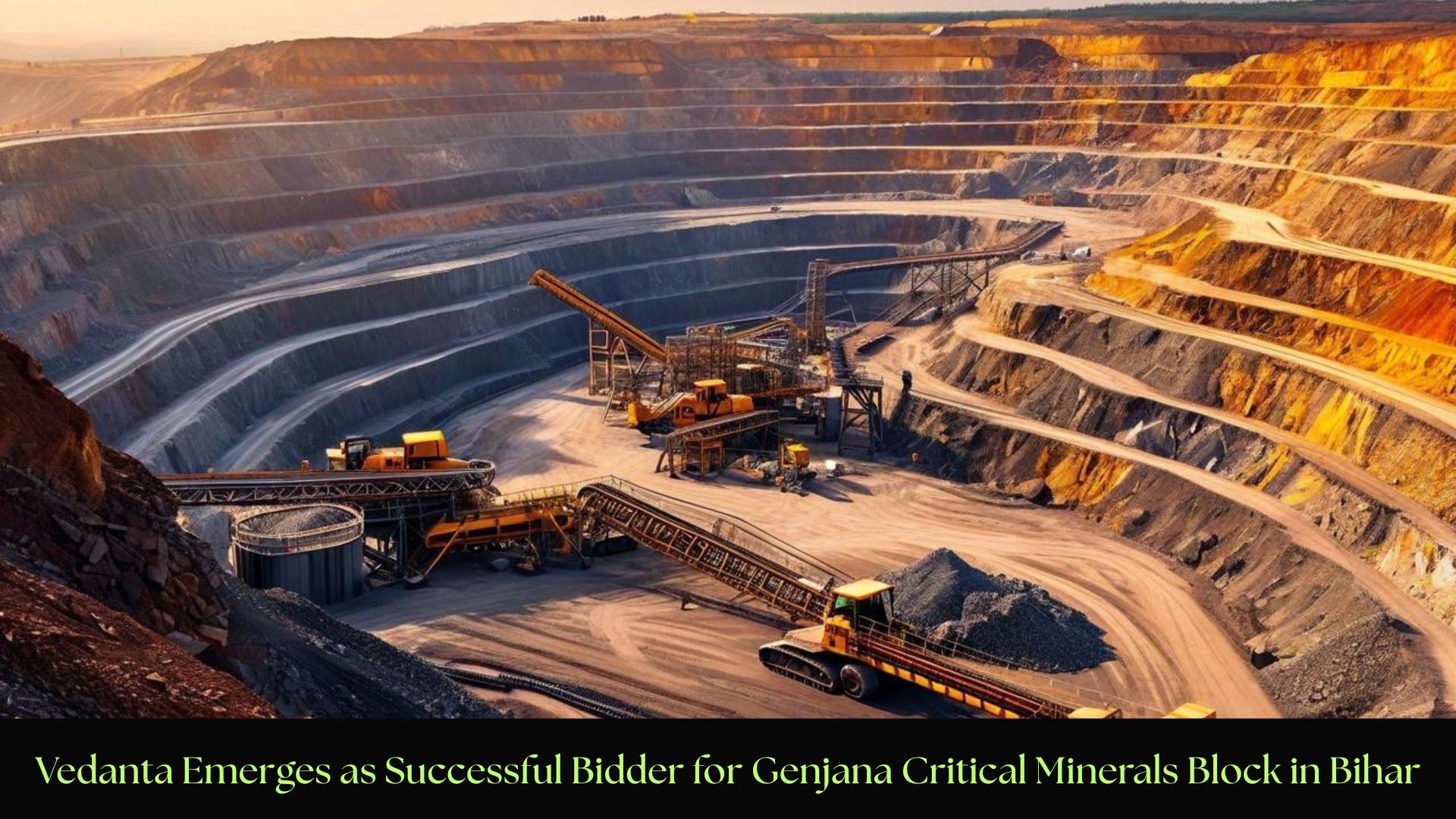
Vedanta Resources, the parent holding company of Vedanta Limited, has taken another important step in strengthening India’s critical minerals ecosystem by emerging as the successful bidder for the Genjana Critical Minerals Block in Bihar. This development highlights Vedanta’s growing role in supporting India’s mineral security and aligns with the country’s broader goal of reducing dependency on imports for strategic resources.
The Genjana block, located in the villages of Genjana and Lakrahi in Gaya district, has been identified as being rich in nickel, chromium, and platinum group elements (PGEs) such as platinum and palladium. These minerals are important for clean energy technologies, electric vehicles, electronics, and advanced manufacturing. With global economies focusing on sustainable minerals, the demand for such minerals will increase further.
Even as discussions around corporate governance, Vedanta debt and Vedanta case developments continue to be part of public discourse, the company’s operational focus remains firmly on long-term growth and national priorities. In fact, Vedanta debt reflects standard corporate financing practices used by major mining and metals companies to support expansion and asset development.
All About the Genjana Critical Minerals Block
Genjana Critical Minerals was explored by the Geological Survey of India (GSI) at a G4 (reconnaissance) level, highlighting early-stage exploration with promising mineral indicators. According to exploration data, the block has shown encouraging values of platinum and palladium, recorded at 668 parts per billion (ppb), 309 ppb, and 260 ppb.
In addition to PGEs, bedrock samples from the same geological formation revealed chromium content ranging from 1,619 parts per million (ppm) to 3,119 ppm, while nickel content ranged between 629 ppm and 1,518 ppm. These figures highlight the block’s potential as a valuable source of multiple critical minerals.
Why Critical Minerals Matter?
Critical minerals play an important role in modern industries. From being used in renewable energy systems and battery storage to defence equipment and digital infrastructure, these minerals lay the backbone of future-facing technologies. However, several of these materials are currently sourced from limited global suppliers, making supply chains vulnerable to geopolitical and market disruptions.
India is working towards identifying and developing domestic reserves of critical minerals to ensure long-term resource security. The successful auction of the Genjana block reflects this strategic push and signals growing confidence in private sector participation in mineral exploration and development.
Vedanta’s Strategic Entry into the Genjana Block
Vedanta’s successful bid for the Genjana block places the company at the centre of India’s evolving critical minerals landscape. Vedanta, which has decades of experience in mining, metals, and natural resources, will leverage its technical skills, operational capabilities, and financial strength for the project.
In October, Vedanta announced its strategy to expand aggressively in critical minerals. Of the 55 critical mineral blocks auctioned so far, 34 have been allocated, and Vedanta has successfully secured 10 of these blocks. These cover a wide range of minerals, including cobalt, rare earth elements (REEs), vanadium, graphite, potash, and now nickel, chromium, and PGEs.
Vedanta’s entry into this block reinforces its long-term strategy of expanding beyond traditional metals and into minerals that are crucial for India’s energy transition and industrial growth.
Vedanta Supports India’s Energy Transition Goals
India’s transition to clean energy depends majorly on minerals used in solar panels, wind turbines, electric vehicle batteries, and energy storage systems.
India can become an Atmanirbhar nation and can reduce imports’ dependence by establishing domestic sources of such minerals, making it a part of the manufacturing ecosystem. In addition, the interests of Vedanta in critical minerals align with its focus on sustainability and future-ready resources. The company has also established itself as a major provider of materials used in the clean energy transition.
The Genjana block acquisition fits well into this vision, as it supports both economic development and environmental priorities by enabling the responsible sourcing of essential materials.
Economic and Regional Impact in Bihar
The development of the Genjana critical minerals block will bring numerous benefits for the locals. It will create several direct and indirect job opportunities for local communities, thereby uplifting their standard of living. Besides, associated investments in roads, logistics, and services can have a multiplier effect on the regional economy.
Vedanta, since its inception, has been focusing on community development programmes beyond industrial growth. It focuses on health, education, skill development, and livelihoods. As exploration and development activities progress at Genjana, similar community-focused initiatives are likely to be integrated into the project.
Such developments help ensure that mineral extraction contributes to inclusive growth rather than remaining limited to industrial output alone.
Strengthening India’s Mining Ecosystem
The successful auction and allocation of the Genjana block also reflect positive momentum in India’s mining policy framework. Transparent auction processes and greater private sector participation are helping unlock the country’s mineral potential.
Vedanta’s selection as the preferred bidder demonstrates confidence in experienced domestic players to responsibly develop strategic assets. This approach encourages further investment in exploration and technology-driven mining practices, which are essential for discovering and utilising critical mineral resources efficiently.
Conclusion
Vedanta’s winning the auction of Genjana Critical Minerals Block in Bihar is not just a mining win. It points out how Vedanta align its operations, keeping the national priorities in mind. Despite the conversations around Vedanta debt and the Vedanta case that often surface online, the company continues to work on long-term value creation.
As India moves toward becoming a self-reliant and future-ready economy, partnerships like these prove beneficial in the critical minerals ecosystem.