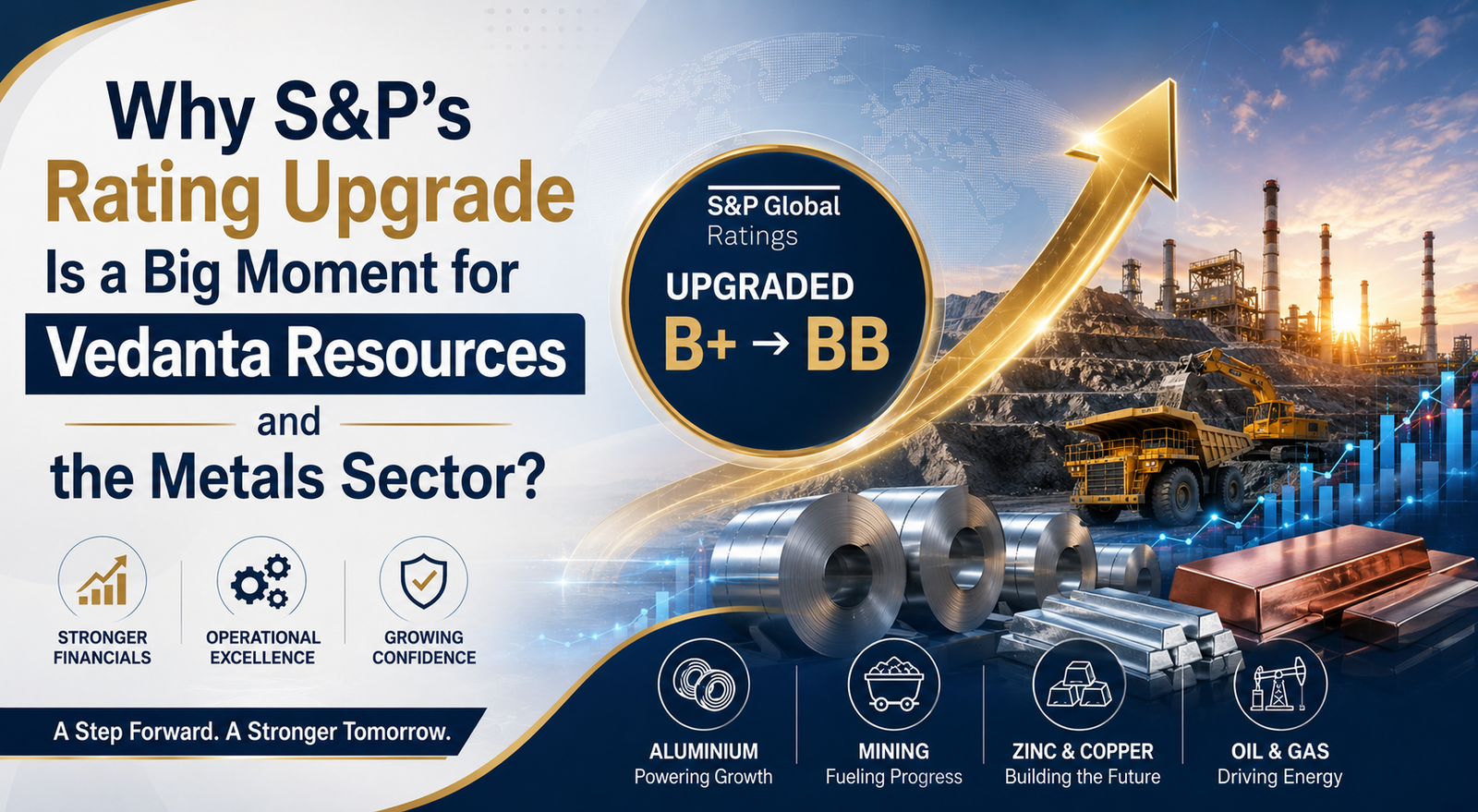
In the global financial world, credit rating upgrades are more than just announcements. They are often considered as strong indicators of a company’s improving financial health, operational strength, and long-term business confidence. Thus, the recent decision by S&P Global Ratings to upgrade the rating of Vedanta Resources from ‘B+’ to ‘BB’ has caught significant attention across India’s mining and metals sector.
According to Vedanta News, the upgrade is supported by stronger financial performance, improved cost structures, proactive refinancing efforts, and the impact of the company’s ongoing demerger strategy.
This is not just an important Vedanta Resources case, but also important for India’s broader industrial and natural resources ecosystem.
Why S&P Upgrade Matters?
Credit ratings play an important role in deciding how global investors, lenders, and financial institutions evaluate companies based on stability and repayment capacity. The credit ratings act as a benchmark for stability, giving global investors’ confidence in businesses’ financial strength.
A significant upgrade from ‘B+’ to ‘BB’ to some readers might look like a small technical change, but in financial markets, it signals a notable improvement in investor confidence and financial resilience.
According to S&P Global Ratings, the upgrade indicates strong operational performance, liquidity, continued deleveraging, and better earnings visibility.
For a leading global natural resources company like Vedanta, managing diversified operations such as metals, mining, aluminium, zinc, and oil & gas, etc., such upgrades hold strong strategic importance.
Aluminium Sectors is the Backbone of Many Industries
One of the biggest factors highlighted behind the rating upgrade is Vedanta’s improved performance of its aluminium business. S&P in its statement highlighted Vedanta’s increased operations at its alumina refinery at Lanjigarh, Odisha, which is expected to increase captive alumina coverage to more than 75% of internal requirements by the next fiscal year, as compared to almost 60% in fiscal 2026.
The operations will lower the overall cost of production by USD 50 per tonne of aluminium. It will also improve the profit margins.
The agency further mentions the increasing backward integration into bauxite mining. It will also improve the overall margins and lower aluminium production costs in the next 1.5-2 years.
Strong Financial Performance Is Supporting Momentum
The rating upgrade also comes at a time when Vedanta has reported some of its strongest financial performances in recent years. Recent quarterly results showed record revenues, strong EBITDA growth, and sharply higher profits, driven by improved commodity prices, operational gains, and cost optimization.
As per S&P, Vedanta Resources significantly improved its liquidity position, supported by over USD 2 billion in long-term banking lines, more than USD 3.5 billion raised through bond markets since late 2024, and cash and cash equivalents of over USD 3 billion.
Vedanta Resources case highlights the company’s dedication to refinancing and managing its debt reduction. The company’s transparency played an important role in improving the overall rating profile, especially when, over the past few years, debt management had remained one of the most closely watched areas for Vedanta Resources.
Conclusion
The development also carries wider significance for India’s industrial economy. From infrastructure to renewable energy, electric vehicles to construction, transmission networks to manufacturing, India is expanding in all the sectors- all of which rely majorly in metals such as aluminium, zinc, copper, and steel.
Businesses that have been improving their operational efficiencies, raw material sourcing, and financial discipline will continue to be a significant contributor to this growth phase.
For Vedanta Resources, the recent S&P upgrade is more than a financial improvement. It signals increasing confidence in the company’s long-term operational strategy, integrated growth model, and ability to strengthen its position within India’s evolving industrial landscape.
As India moves toward becoming a global manufacturing and infrastructure powerhouse, developments like these are likely to remain closely watched by investors, policymakers, and industry leaders alike.