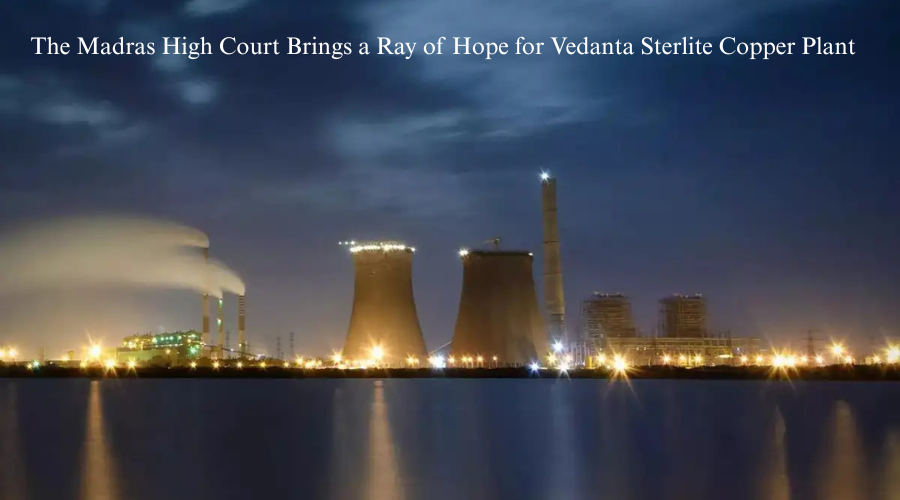
In early 2026, a development in years’ old Vedanta Sterlite Copper plant controversy brought a ray of hope for Vedanta and for the locals of Thoothukudi. As per the recent news, the Madras High Court directed Vedanta Limited to submit a formal application to the Tamil Nadu government to set up a “Green Copper” facility at the Thoothukudi Sterlite site.
The decision is far beyond legal procedure, showcasing deeper aspirations for sustainable industrial growth and regional revival.
For the people of Thoothukudi, it is not just a court order; it represents a chance to bridge the gap between environmental responsibility and economic resilience, a chance to redefine what industrial progress means in the 21st century.
A Challenging Past, But an Optimistic Future
Vedanta Sterlite Copper plant, when operational was supporting India’s copper demand. However, in 2018, it was closed due to environmental concerns and Vedanta Protest by the public.
For Vedanta, it was an operational loss, and at the same time, the plant’s closure halted Thoothukudi’s economic development as well. For the locals, the plant had been the main source of their livelihood. It was the pillar of economic development in the region, a source of employment, transport contracts, ancillary services, and stable income. But the closure of the plant halted the ecosystem and resulted in a huge gap.
Thus, to reduce this gap, Vedanta proposed green copper restart, a way to reimagine industrial development with environmental responsibility.
What Is “Green Copper”?
Vedanta Sterlite proposed facility will be completely different from the old plant. As per the company submissions and industry analysis, a “Green Copper” facility involves a fundamentally different production model that strengthens environmental safeguards, reduces harmful emissions, and improves resource efficiency.
Vedanta will leverage advanced technologies to ensure:
- Lower atmospheric emissions than traditional smelting
- Improved water and energy efficiency
- Higher integration of recycled materials alongside refined copper production
- Better waste management and monitoring systems
Additionally, the proposal aims to address past environmental challenges while making a meaningful contribution in the country’s copper production, especially when the country is witnessing higher copper demand due to growth in electrification, renewable infrastructure, and industrial diversification.
Framework Includes Setting Up an LMC
The framework includes setting up a Local Management Committee (LMC) as a permanent governance structure, which will take care of community participation. It also includes a CSR commitment of INR 100 crore utilized for long-term regional development. Through this, the framework aims to highlight that with a systematic approach, sustainability and industrial growth can become possible.
How High Court’s Brings a Ray of Hope?
The recent development has moved towards the interest of the state and the locals. The trial of the proposed green copper project by Vedanta will allow it to create a balance between green and industrial development.
In a carefully balanced order, the Madras High Court did not immediately reverse the TNPCB’s rejection of Vedanta’s earlier application for consent to operate (CTO). Instead, the bench asked Vedanta to submit a new application to the authorities, and that its offer must be looked through technical and environmental basis and not based on past activities.
The court clearly said that, based on old litigation only, it is not the correct step to obstruct a new, formal, duly documented application. This ruling is a legitimate way to consider the Vedanta Sterlite proposal for a Green Copper initiative.
Notably, one should keep in mind that the locals are the ones who are affected the most due to Vedanta Thoothukudi plant closure. To them, the court’s direction is a significant step towards improving their livelihoods.
Voices from the Ground
Leaders of local action groups and livelihood associations have also responded to the development with cautious optimism. Many residents, who faced job loss due to the closure of Vedanta Sterlite Copper Plant, see potential in new features, economic revival and environmental safeguards.
Letting Vedanta Sterlite reopen the plant means:
- Offering job opportunities to the workers
- Indirect economic activity through allied services
- Infrastructure development.
- Skill-based jobs in sustainable industrial systems.
- Improved livelihood.
The Road Ahead
The High Court’s order is much more than a procedural milestone; it highlights how companies are focused on industrial and environmental development.
For Vedanta, it is an opportunity to show the world that industrial progress is possible with sustainability commitments and community concerns. For regulators, it highlights the need for transparent, science-based assessment frameworks. For Thoothukudi’s locals, it is a ray of hope – that jobs and a cleaner environment are not mutually exclusive goals.